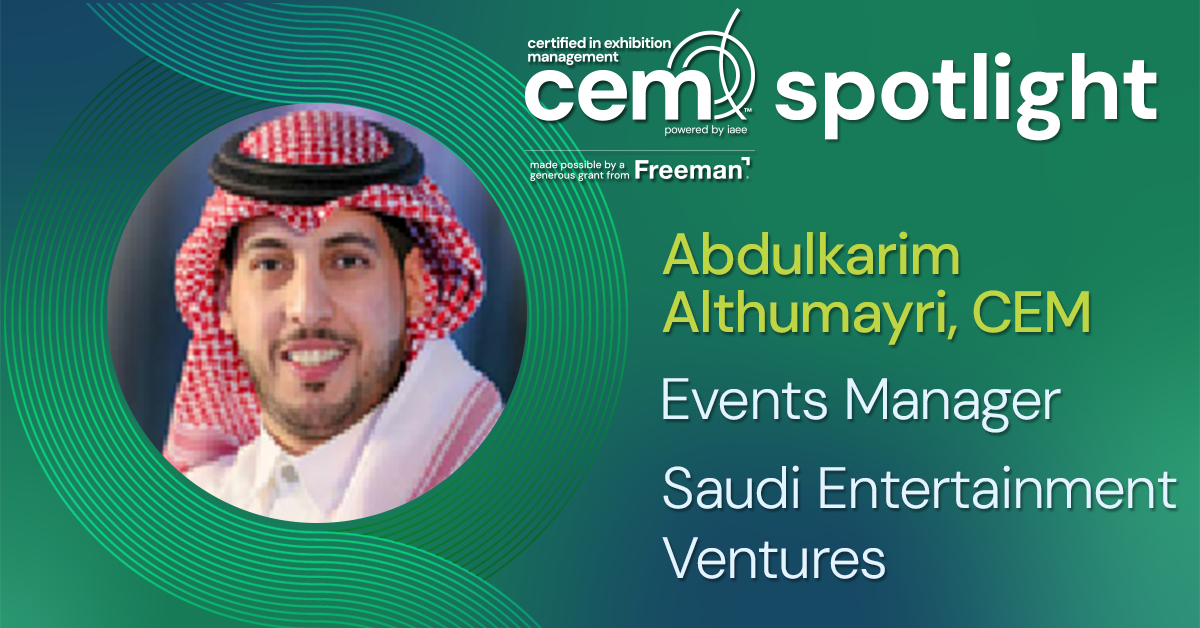
Abdulkarim Althumayri, CLMP, CEM is a senior loyalty, partnerships and events professional with more than 10 years of experience in Saudi Arabia’s entertainment sector. Currently serving as the Events Manager for Saudi Entertainment Ventures, he has led major cinema openings, high-profile premieres, and strategic partnerships with global brands and government entities. Abdulkarim holds a master’s degree in Management Information Systems and is a Certified Loyalty Marketing Professional.
Abdulkarim recently earned IAEE’s Certified in Exhibition Management® (CEM) designation. Here, he shares how it is helping him elevate Saudi Arabia’s exhibitions and events industry through world-class expertise and international best practices.
How has the CEM designation helped in your career?
The CEM designation boosted my credibility, expanded my knowledge across all aspects of event management and opened new career opportunities. It also connected me to a global network of professionals and keeps me engaged in continuous growth.
Why is it important to maintain the CEM designation?
Maintaining the CEM designation is important because it shows you are staying current with industry trends, continuously developing your skills, and upholding a globally recognized standard of professionalism. It also keeps your credibility strong with employers, clients and peers, while ensuring you remain part of the active global CEM network.
What made you want to obtain your CEM designation?
I wanted to obtain my CEM designation to strengthen my professional credibility, build a structured foundation in exhibition and event management, and gain a competitive edge in advancing my career. It was also a way to connect with a global network of industry professionals and commit to continuous growth.
What advice would you give to an aspiring individual who wants to apply for the CEM program?
My advice is to go for it with clear intent – the CEM program is a valuable investment in your career. Be ready to dedicate time to each module, apply the learnings to your current role, and actively engage with the global CEM community. It’s not just about earning the designation, but about building skills, credibility and connections that will set you apart.
How did you start your career in this industry?
I began my career in the industry through loyalty and customer engagement, where I worked on programs that blended sales, partnerships and member experiences. This role naturally exposed me to events and activations, from cinema premieres to partnership-driven initiatives. Over time, my focus shifted more toward large-scale events and launches, which became the foundation for my transition into full-time event management.
How have you made a difference with your show or with working with a client by applying the knowledge you gained by obtaining your CEM designation?
By applying the knowledge from my CEM designation, I’ve been able to bring more structure and strategy to my events – especially in areas like risk management, budgeting and audience engagement. For example, when managing high-profile premieres and large-scale openings, I used CEM frameworks to streamline vendor coordination, enhance guest flow and align every touchpoint with brand objectives. This not only improved the guest experience but also delivered measurable value to clients and stakeholders.
What was it that you did or implemented right after obtaining your CEM?
Right after obtaining my CEM, I started applying its structured frameworks to my projects – especially in event planning, risk assessment and stakeholder management. I refined how I developed timelines, vendor briefs and evaluation metrics, which immediately improved efficiency and gave more confidence to leadership and clients in the way events were delivered.
What did you like most about the CEM Learning Program?
What I liked most about the CEM Learning Program was how practical it is – the modules directly connect to real-world challenges in event management. I also valued the global perspective, learning from both the content and the community of professionals who shared best practices and diverse experiences.
What is one thing most people don’t know about you?
A fun fact about me is that I originally started in loyalty and partnerships, not pure events – yet that path led me to manage over 25 major premieres and cinema launches. Most people don’t realize that my foundation in customer engagement and loyalty is what shaped my approach to creating memorable event experiences today.