
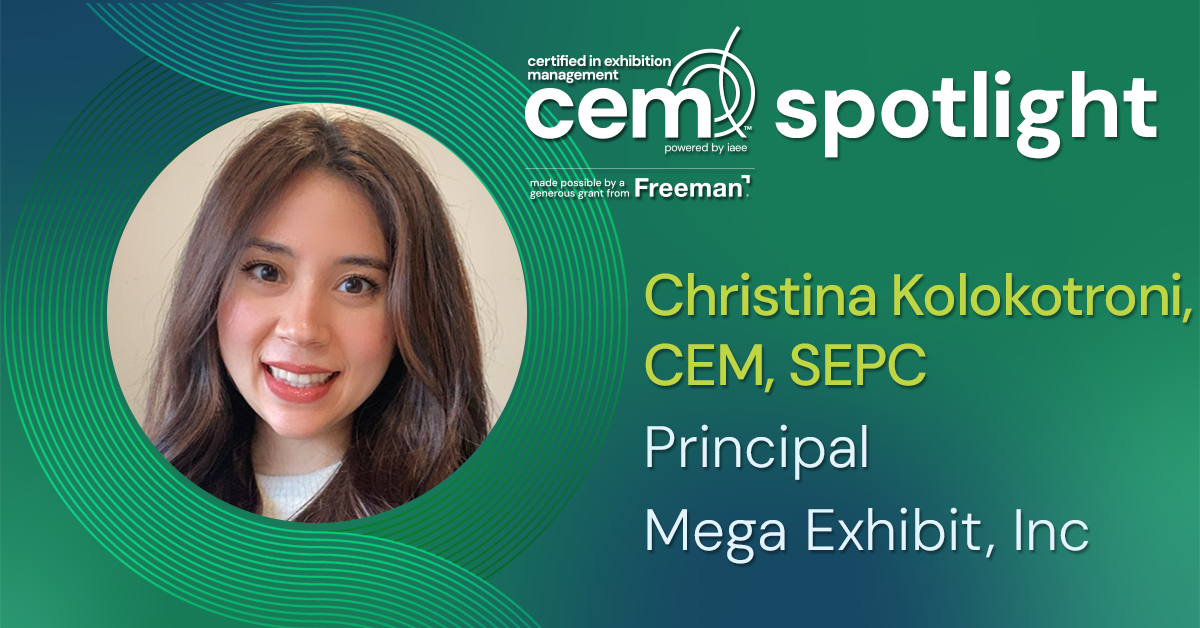
By Christina Kolokotroni, CEM, SEPC | Principal | Mega Exhibit, Inc
I didn’t start my career with a plan to work in events.
I fell into it.
In 2016, I joined the internal events team at Samsung, and that was my first real exposure to how much goes into producing an event. At the time, I saw what most people see: the end result, the experience, the final build.
What I didn’t fully see yet was everything underneath it.
I remember a moment early on that has stayed with me. I was walking a show with a more senior team member who had far more experience than I did. I remember looking around thinking everything felt impressive. The booth, the energy, the overall execution.
Then they started asking questions. Not about what was visible, but about what wasn’t. They questioned the load-in schedule, labor sourcing, contingency plans and how each decision connected back to the actual objectives. In that moment, I realized there was an entire layer of this industry I hadn’t yet been exposed to. That was when I stopped simply looking at events… and started understanding how they actually work.
A few years later, I transitioned to the agency side, and that shift changed everything. It’s always easier being the client. On the agency side, you’re responsible for making ideas real, budgets, timelines, labor, materials, logistics and every decision behind the scenes.
Today, I’m the Principal of Mega Exhibit, a family-built experiential company where we design, fabricate, and install trade show exhibits and brand activations from the ground up. My perspective wasn’t built in theory. It was built across the full project lifecycle: creative development, design, fabrication, logistics and on-site execution, where timelines are tight and every decision carries weight.
Being part of a family business hits different. You’re not just responsible for one piece. You’re exposed to all of it, and you feel the weight of every decision along the way.
Over the past decade, I’ve watched this industry evolve rapidly. Technology has advanced, access has expanded, timelines have compressed and expectations have increased. All while budgets have tightened, and costs across materials and labor have continued to rise.
But one thing has remained consistent:
Most challenges in this industry aren’t creative problems, they’re structural ones.
Misalignment, lack of planning and decisions made in silos are what ultimately break an event.
By the time I pursued my Certified in Exhibition Management (CEM) designation, I already had ten years of experience. I knew how to execute, problem-solve and build.
What I was looking for was refinement.
The CEM didn’t teach me how to do events, it gave structure to what I had already experienced. It connected the dots across marketing, sales, operations and finance; areas that are often treated separately, but in reality are deeply interconnected.
The biggest shift for me was perspective.
Earlier in my career, I relied on experience, reacting quickly and solving problems in real time. Over time, that evolved into a more intentional approach, which the CEM helped reinforce and structure by aligning stakeholders earlier, thinking through the full lifecycle, and identifying risks before they surface.
Because once you’ve been in this industry long enough, you realize:
The show floor isn’t where things break, it’s where misalignment becomes visible.
This was particularly evident in how I approached CES and our work around NBA All-Star this year.
Both operate at a scale where complexity is expected. Multiple stakeholders, compressed timelines and very little room for error.
Instead of solving issues as they came up, I focused on aligning everything earlier, before design, before fabrication, before anything hit the show floor.
Because at that level, you don’t fix problems later.
You either account for them early or feel them in real time.
This industry is evolving quickly, and experience alone isn’t enough to stay ahead. You have to continuously refine how you think.
That’s what the CEM provides.
It offers a framework that allows you to move from reacting to events to leading them with intention.
And in an industry where so much happens behind the scenes, clarity is what allows you to connect decisions, align teams and build experiences that actually hold up under pressure.
Because great events aren’t just built on creativity, they’re built on alignment.
And that’s what turns an idea into something that works, from render to reality.