
By Mary Tucker | Senior Communications and Content Manager | IAEE
The IAEE Lifetime Achievement Award is a special honor reserved for members whose decades of service have changed the direction of exhibitions and events through a significant impact on how our industry operates. This prestigious award is not presented annually, nor is it open to nominations. It stands apart from all other IAEE honors because nominees can only be put forward for consideration by IAEE’s Awards Committee or Board of Directors – a recognition reserved exclusively for those whose contribution is so profound and far-reaching that it demands acknowledgment at the highest level.
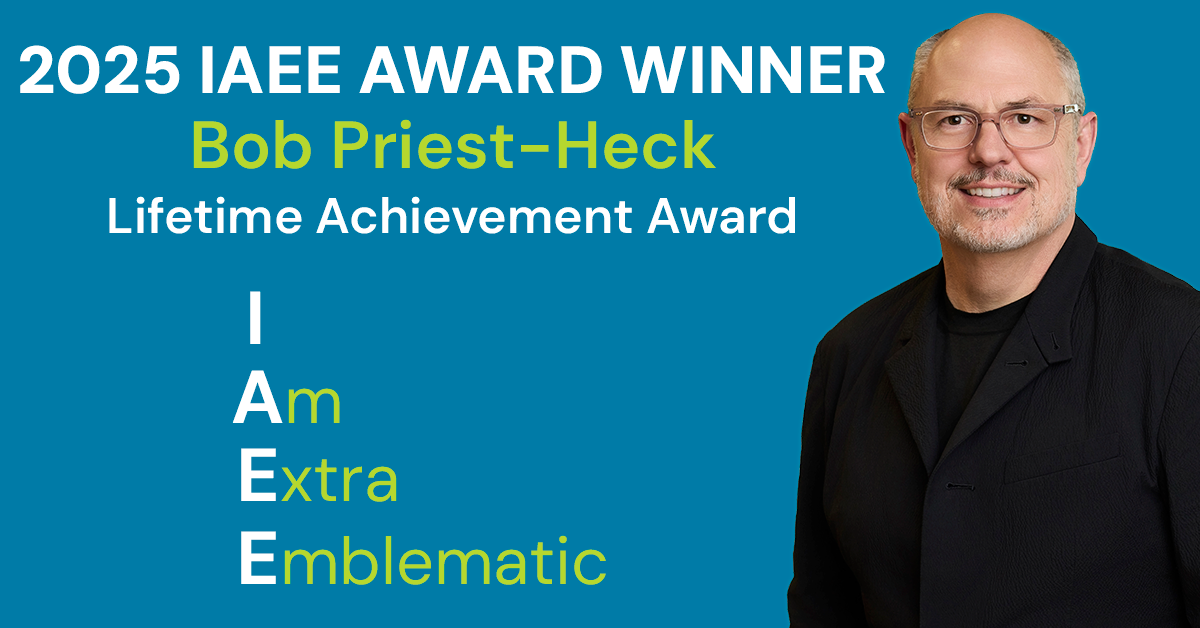
In 2025, that distinction was awarded to Bob Priest-Heck.
With more than 30 years of visionary leadership, Bob has been a catalyst and driving force behind powerful advancements that now define our industry. From his early days as a National Association of Exhibition Management (now IAEE) member in 1991, working on groundbreaking events like Digital World and COMDEX, to his tenure as Freeman’s first non-family CEO, Bob consistently operated at the intersection of innovation and tradition. He championed digital transformation before it became an industry buzzword, established data-driven decision-making as standard practice through initiatives like CEIR Predict, and created the blueprint for how our industry responds to crisis through Go Live Together (now the Exhibitions & Conferences Alliance).
But Bob’s legacy extends far beyond business achievements. He intrinsically changed how our industry approaches sustainability, workplace culture, diversity and talent development – ensuring that the next generation inherits not just a thriving industry, but a more equitable, responsible and forward-thinking one.
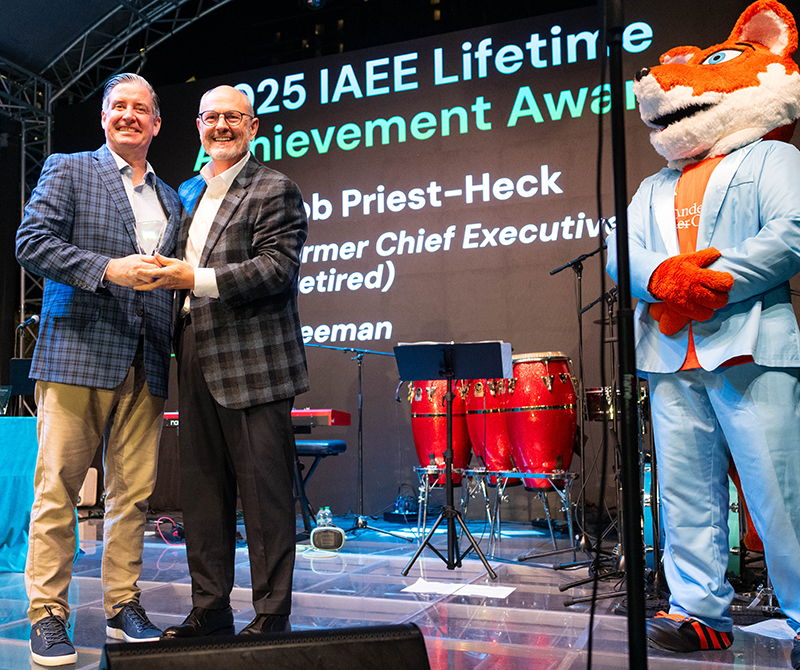
Bob was presented the 2025 IAEE Lifetime Achievement Award this past December at Expo! Expo! IAEE’s Annual Meeting & Exhibition in Houston, Texas.
Retired as of 2024, Bob continues to influence the profession through his co-authored book “Inside Live Events” and the countless leaders he mentored throughout his career. We sat down with him to reflect on his remarkable journey and gather insights from a lifetime dedicated to elevating our industry.
In our conversation, Bob shares reflections on three decades of industry evolution, the lessons learned from navigating unprecedented challenges, and his vision for the future of exhibitions and events.
Looking back over your 30+ year career, from working on Digital World with innovators like Steve Jobs to leading Freeman through the digital age, what moment or decision do you feel was most pivotal in shaping not just your career, but the trajectory of the entire industry?
Bob: There are so many things, in hindsight, that seem pivotal. But I guess the earliest one was back in the ‘90s at JavaOne. Conventions and trade shows were largely show-and-tell events. But the challenge we embraced was earning mindshare with the wild west of software developers. No one had tried to attract them to an event, and for good reason. They were notoriously independent – each preferring their own programming language, their own way of working, and their own sleep patterns.
All the research said that programmers held a deep distrust of marketing. They would only listen to messaging that felt authentic. Authentic, for their purposes, came to mean activities programmers preferred when left to their own devices. So, every aspect of the show was created using that filter. And it was unbelievably successful. From that moment on, this learning applied to every esoteric audience we designed for. If you build it, they will come. It’s standard practice today.
The pandemic brought our industry to a complete standstill, yet you responded by creating Go Live Together and uniting more than 80 industry leaders to advocate for 6.6 million affected workers. What did that crisis teach you about the industry’s resilience, and what do you wish you’d known at the beginning of that journey?
Bob: There are a number of things that came out of the pandemic. The most startling for our Freeman team was the realization that the business events industry desperately needed representation in Washington, D.C. We were invisible or, even worse, completely misunderstood. That was the crux of Go Live Together and ultimately the ECA (Exhibitions & Conferences Alliance). Our industry was not seen as essential to the global economy, even though something like 50% of all GDP goes through trade shows and events.
At both a Federal and State level, legislators didn’t understand that our industry was vital to driving the economy and getting it back open as soon as possible was important. So it became critical to get out there and educate legislators on the value proposition of business events, and how to get events back open and running safely, because it was a massive economic driver. Freeman led that charge, but everyone quickly got on board. And the need for representation at a Federal level is an ongoing need; we can’t ever take that for granted.
And of course, on a human level, the big lesson that came out of the pandemic is a confirmation that people have a need to connect face-to-face, which makes the events industry more important than ever. It would have helped our planning if we understood how Federal regulations were going to unfold or when the vaccines would be available… but frankly I’m glad I didn’t know how long the shutdown was going to last! The rewarding part was seeing how much industry people care about the work we do and were willing to go the distance, because they believed in the cause and in each other.
You were an early advocate for sustainability and equity in our industry, from signing the Net Zero Carbon Events pledge at COP 26 to championing workplace culture that earned Freeman recognition as one of Forbes’ “Best Employers for Women” for three consecutive years. What advice would you give to current industry leaders who are still navigating these commitments?
Bob: Relating to sustainability issues, we need to keep pushing for better data and data hygiene. Push for consistent, actionable data. Push for standards that can apply equitably to all involved in events so that our cumulative actions add up to meaningful progress.
Freeman had an amazing culture long before I showed up, and the commitment to diversity wasn’t a hard sell, because it was the right thing to do. The hard part was getting the metrics right. This applies to any Employee Resource Group (ERG). Don’t just pledge “help;” invest in and measure your progress against any changes you hope to affect.
Through innovations like Freeman’s Camp Buck to develop leadership, programs that invite emerging leaders to inform policy and outreach at all levels of academia, you influenced how our industry develops talent. In retirement, as you observe the next generation taking the reins, what gives you the most hope about the future of industry leadership? Conversely, where do you still see room for improvement?
Bob: Our industry is built on helping people connect, so people are always at the heart of what we do. With the talent deficit, it’s more important than ever that we recruit, mentor, train and empower people. As I said earlier, improvement is still needed in the area of raising visibility for our industry. There is so much opportunity here.
The Boomers and to some extent Gen X found this industry by accident. Right place at the right time. But today’s leaders need to be much more intentional about attracting new people, at all levels of the enterprise. We are seeing an evolution in how we think about education, training and requirements for hiring. Not every job in our industry needs a four-year college degree; many need even more on-the-job-specific training than most colleges provide. We need to recruit, mentor and job shadow – focusing on attracting the right people and supplementing their education as needed. We can work with trade unions to clear a path to lucrative, secure careers in the trade show and exhibition industry. There’s so much opportunity.
I’m glad to see Freeman working closely with academia to help develop the talent we need going forward. It’s why I’m mentoring a master’s candidate at San Diego State who is already pursuing a career in events. Freeman has great relationships with a number of universities. We had a presence at Rock Lititz, which does amazing work immersing high school and college students in the breadth of careers available.
As for Camp Buck, it’s Freeman’s way of getting leadership together, inspiring the individual, building a collaborative spirit, and affirming our core values even in the face of continuous change. It’s awesome.
I am optimistic about this generation of young leaders because they are so much smarter than I was at their age. I mean, we were winging it a lot of the time. But this generation demands answers, and can use technology to find answers and explore unheard of possibilities. They have high expectations, which is great. My hope is that with AI and whatever the next tech is, industry leaders do not lose sight of the essential human factor. I’ve always said people are the killer app, and I stand by that.
You co-authored “Inside Live Events” specifically to attract new talent to our profession. If you could offer a single piece of advice for someone just entering the industry today, what would it be?
Bob: We don’t know what we don’t know, right? In terms of the book, it was designed as a sort of reference guide. And it’s really the collected wisdom of people from Freeman and throughout the industry. So whether you are new or an industry veteran, don’t assume you have all the answers. For example, if you’re developing a strategic plan, there’s a section of the book that can help you ask the right questions, maybe jog your memory regarding something you might have overlooked. If you’re an exhibitor, or someone helping an exhibitor, there’s a robust “to do” list. Same with designers – it’s filled with prompts to help you think about things in a fresh way.
Ultimately, our industry needs to attract people who want something more out of their career than predictability. It’s dynamic. We build worlds and take them down three days later. That should be impossible. Success is always about connection – about building relationships. Imagination, creativity, a solid work ethic – these thing are critical. But my advice is that success is built on relationships and a willingness to collaborate in a way that inspires everyone to do more. Empathy is foundational to building the trust that allows people to believe they can do something impossible time and again. Further, my advice to future leaders is don’t only focus on short-term results; think about the long-term health of the business and the industry. Don’t be afraid to ask questions and don’t be afraid to demand answers. Own the opportunity to be the answer.