
By Mary Tucker | Senior Communications and Content Manager | IAEE
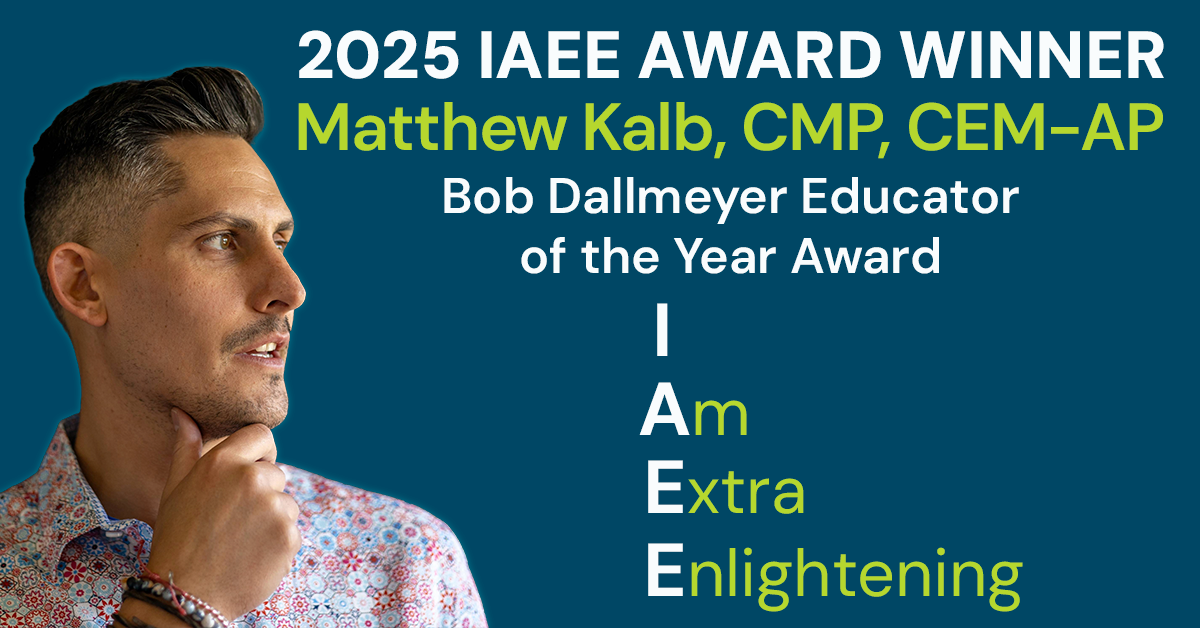
What makes a truly exceptional educator in the exhibitions and events industry? It’s someone who doesn’t just teach concepts but transforms how professionals think, lead and grow. Matthew Kalb, CMP, CEM-AP, Vice President of Client Experience at T3 Expo, exemplifies this standard of excellence as the 2025 recipient of the prestigious IAEE Bob Dallmeyer Educator of the Year Award.
This honor recognizes members who demonstrate outstanding creativity, positive attitude, and the ability to transfer knowledge through exceptional communication and innovative teaching. Matthew has earned this recognition through his unique approach that bridges theory and practice, making complex industry concepts relatable through real-world applications and evidence-based content. As both a Certified in Exhibition Management® (CEM) instructor and sought-after speaker at conferences like Expo! Expo! IAEE’s Annual Meeting & Exhibition and SHRM, he creates learning experiences that empower participants with immediately actionable skills.
Beyond the classroom, Matthew’s commitment to mentorship sets him apart. He actively invests in developing future educators, encouraging former students to pursue instructor roles and maintaining relationships that catalyze career advancement. With more than 15 years of IAEE membership and extensive service including as Immediate Past Chairperson of the CEM Commission, Matthew embodies IAEE’s mission to promote lifelong learning in the exhibitions and events industry.
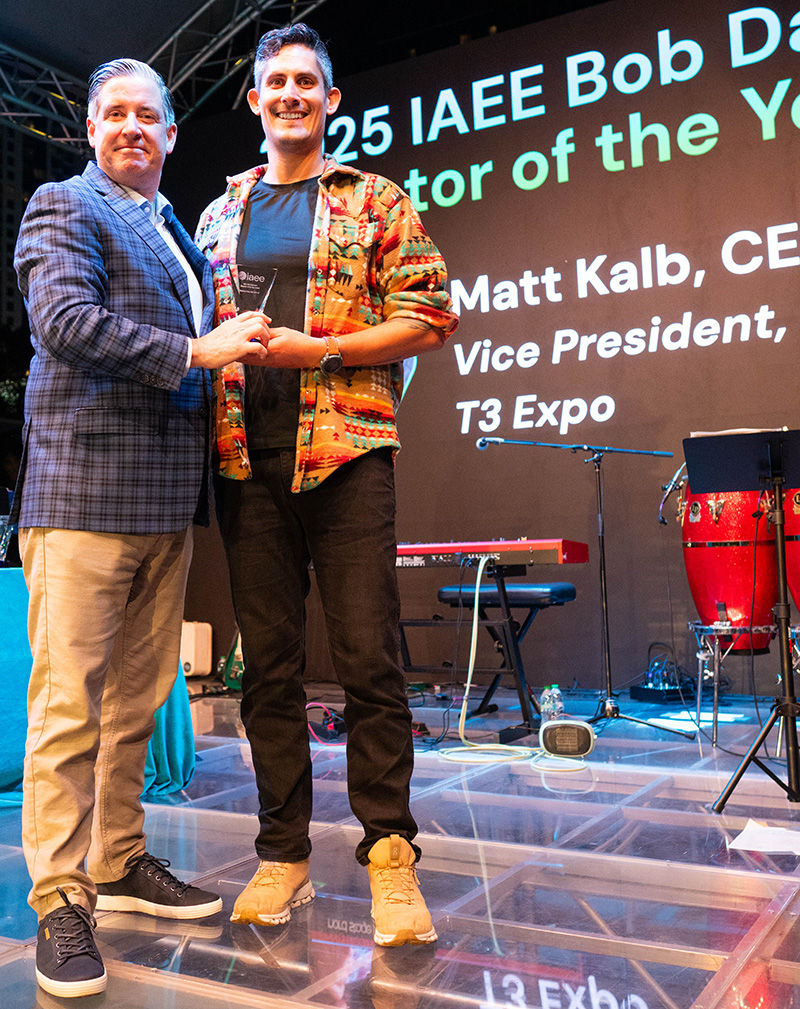
Matthew was presented the 2025 IAEE Bob Dallmeyer Educator of the Year Award this past December at Expo! Expo! IAEE’s Annual Meeting & Exhibition in Houston, Texas.
In this conversation, we explore Matthew’s educational philosophy, his insights on contemporary workplace challenges and his vision for developing the next generation of industry leaders.
Your nominators praised your ability to make complex concepts relatable through storytelling and real-world applications. What’s your philosophy on translating theory into practice, and can you share an example of how you’ve made a traditionally dry topic come alive for your students?
Matt: I remember being in school and struggling to truly understand theory, and carrying a lot of shame around that. It took me years to shift my mindset and realize it wasn’t that I didn’t understand the material, but that I couldn’t yet see how to put it into practice.
Much of what I share with my students today are things they already feel or have experienced in practice. My role isn’t to introduce something foreign, but to help them make sense of what they already know intuitively. Storytelling plays a big role in that. When I share real experiences, often my own missteps, it gives people a mirror before it gives them a model.
By connecting those stories and lived experiences to what’s happening in the mind and body, I help shine a light on why we feel the way we do and how that awareness can inform better decisions moving forward.
You’ve recently focused on psychological safety, inclusive leadership and company culture in your teaching. What prompted this shift, and why do you believe these topics are critical for today’s industry professionals?
Matt: Honestly, it wasn’t a shift as much as a realization. I kept seeing incredibly capable professionals struggle, not because they lacked skill, but because they didn’t feel safe enough to speak up, challenge ideas, or admit mistakes.
For a large portion of my career, I worked without true psychological safety and didn’t fully realize what was missing at the time. Once you experience it, you can’t unsee it. You wonder how you ever operated without it. The difference in engagement, creativity, and authenticity is striking… even to yourself.
Psychological safety sits underneath everything else we care about: innovation, retention, leadership development, and operational excellence. Without it, teams default to self-protection rather than collaboration, because that’s where the brain feels safest.
The events industry is fast, complex, and pressure-heavy. Emotions run high and decisions happen quickly. Leaders who understand how the brain responds to stress, uncertainty, and belonging are better equipped to build teams that perform and sustain themselves. These topics are often labeled “soft skills,” but they are core infrastructure.
Mentorship is a cornerstone of your approach, as you actively encourage former students to become instructors themselves. What drives this commitment to developing future educators and what advice do you give to someone considering stepping into a teaching role?
Matt: I didn’t get here on my own. I owe much of my career to Mark Shadwick, who was endlessly patient with my questions and, importantly, never rushed to give me the answers. Along with others, he challenged me, called me out when needed, and trusted me before I fully trusted myself. That experience shaped how I view mentorship today as a responsibility, not a title.
Encouraging former students to step into teaching roles is about expanding the number of voices in the room. Our industry is stronger when education reflects a wide range of paths, perspectives, and lived experiences.
My advice to anyone considering teaching is simple: don’t focus on having all the answers. Focus on creating space for better questions, rooted in curiosity. Every time I facilitate a course, I walk away having learned as much (if not more) than I brought in. If you find yourself thinking, “I wonder how else we could do that,” that curiosity may be your signal to step forward.
Given your tenure with IAEE and extensive involvement, you have a front-row seat to the industry’s evolution. How has your teaching adapted to address emerging challenges and opportunities in the exhibitions and events space?
Matt: My teaching has become less about “how things have always been done” and more about how people think, decide, and adapt in uncertainty. The pace of change isn’t slowing down, which means memorizing processes matters less than reflection, and emotional intelligence.
The old saying “if it isn’t broken, don’t fix it” feels antiquated in today’s environment. We now have access to tools, data, and perspectives that allow us to work more intentionally and efficiently. When something is working well, I encourage asking not only why it works, but whether it can be made better, and how those improvements might translate elsewhere.
I’ve also leaned more into facilitation than lecture. Today’s professionals don’t need more information, they need help making sense of it. That means designing learning environments where participants learn with and from each other, not just from the front of the room.
Looking ahead, what skills or mindsets do you believe are most essential for the next generation of professionals to cultivate, and how are you working to instill these in your students today?
Matt: Curiosity, self-awareness, and the ability to sit with discomfort. The next generation doesn’t need permission to lead differently, but they do need environments that support experimentation and learning from failure.
In my teaching, I focus on normalizing reflection, reframing failure, and helping people understand their own triggers and biases. When professionals understand how they show up under pressure, they lead more intentionally.
If I’m doing my job well, students leave with fewer “right answers” and more confidence in how they think, ask questions, and support others.