
By Mary Tucker | Senior Communications and Content Manager | IAEE
The IAEE International Excellence Award stands as one of the industry’s most prestigious honors, recognizing members and organizations that have elevated the attractions sector on a global scale through exceptional exhibitions, innovation and representation.
Last year’s recipient demonstrated extraordinary commitment to advancing the industry through their groundbreaking work at IAAPA Expo Europe 2024. Held at the RAI in Amsterdam, the event set new records as the largest European show in IAAPA’s history, welcoming 17,370 verified attendees – an impressive 41% increase from the previous year. The trade show expanded to 8,870 square meters, providing an unprecedented platform for 685 companies to showcase their latest innovations and services.
Beyond its impressive scale, the event brought together 200 expert speakers from 20 countries, delivering 60 education sessions that served as vital knowledge-sharing opportunities for attendees. New targeted receptions, enhanced networking spaces, and innovative additions such as the Tech Forum at Beda University of Applied Sciences helped transform the expo into a truly comprehensive industry experience.
IAAPA Expo Europe 2024 was presented the 2025 IAEE International Excellence Award this past December at Expo! Expo! IAEE’s Annual Meeting & Exhibition in Houston, Texas.
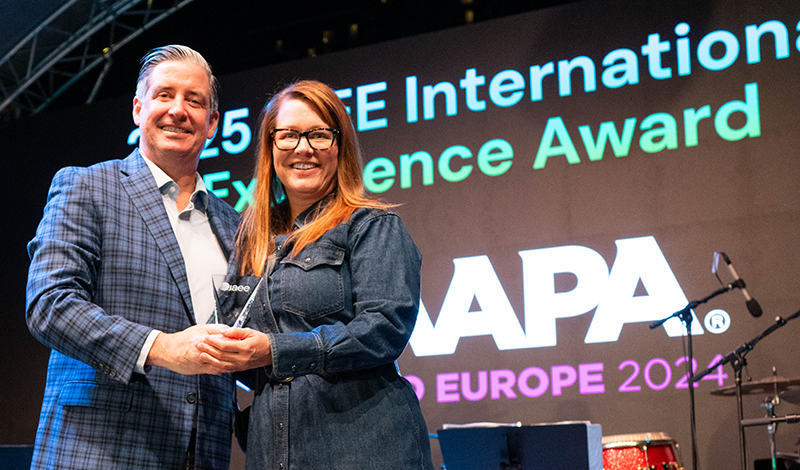
We sat down with Peter van der Schans, Executive Director and Vice President IAAPA EMEA, to discuss his vision, the challenges of organizing Europe’s largest attractions trade show and what the future holds for IAAPA Expo Europe.
IAAPA Expo Europe 2024 achieved a 41% increase in attendance from the previous year. What strategies did you implement to drive such remarkable growth, and what moment during the planning process made you realize this would be a record-breaking event?
Peter: To achieve a 41% increase year over year in attendance, we implemented a multifaceted strategy focused on expanding reach, deepening engagement and activating every stakeholder across the ecosystem. A key driver of this success was empowering exhibiting companies with tools and tailored assets that made it easy for them to engage and invite high-value prospects.
In parallel, we launched a comprehensive omni-channel marketing campaign that extended well beyond the IAAPA membership base. This included targeted digital outreach, high-visibility placements, and personalized messaging that kept the Expo top-of-mind for both returning attendees and new audiences. We complemented this with a robust trade media and association engagement program, ensuring that coverage of the Expo began months in advance and reached every corner of the attractions industry.
Public relations played a pivotal role in this success. We secured sustained pre-event media coverage that elevated the Expo’s relevance and visibility, while a robust referral marketing initiative activated attendees, exhibitors, speakers, and sponsors across social platforms.
Early registration reports signaled momentum well above expectations, but the true inflection point came approximately two weeks before the show, when registrations surged at an unprecedented pace. At that moment, it became clear that we were not simply on track for a strong year – we were poised to deliver a truly record-breaking edition.
You introduced several innovations this year, including the Tech Forum at Breda University and new targeted receptions. Can you walk us through the decision-making process behind these additions and share any attendee feedback that particularly validated these choices?
Peter: Innovation remains a central principle, and each edition of the Expo introduces new opportunities designed to deliver meaningful value for attendees. Planning for this year’s program drew heavily on insights from post-Expo research, which consistently identifies networking as one of the primary motivations for participation. Attendees seek to expand their professional networks, connect with peers in similar segments of the industry and engage in conversations that support business growth. This insight directly influenced the launch of targeted receptions – purposefully curated settings that enable participants to meet others who share their specific focus areas. The format has demonstrated strong effectiveness in fostering high-quality, productive interactions.
Consideration is also given to the distinctive attributes of the host country each year, with an emphasis on identifying opportunities that leverage local expertise. The proximity of this edition to Breda University – an institution widely recognized for leadership in leisure, tourism and experience design – presented a natural opportunity for collaboration. The Tech Forum emerged from this alignment, offering a program that combined academic perspective with industry relevance and giving attendees an elevated platform for deeper learning.
Coordinating 200 speakers from 20 countries is no small feat. How did you curate the educational program to ensure it addressed the most pressing trends and challenges facing the attractions industry today?
Peter: The overarching priority is to ensure that the program delivers relevant and timely insights that reflect the most current trends and challenges in the attractions industry, while maintaining a strong focus on educational value.
The process begins with an open call for proposals, inviting professionals from across the global attractions community to submit ideas. This approach generates a diverse pool of topics and perspectives. All submissions are then reviewed by a dedicated education committee composed of member volunteers from the industry. This group evaluates the proposals, identifies the themes with the highest strategic importance, and collaborates to shape a balanced and impactful program.
Attendee input is central to the decision-making process. During each Expo, participants rate every session they attend, providing real-time insights into the content that resonates most strongly. Additional surveys capture the subjects attendees would like to see expanded or newly introduced. These data points directly inform the development of the following year’s program, ensuring that the agenda remains aligned with the industry’s evolving priorities.
Through this combination of open participation, expert volunteer guidance and continuous attendee feedback, the educational program is crafted to deliver meaningful, relevant and high-quality learning experiences year after year.
Amsterdam and the RAI proved to be an exceptional location for this scale of event. What factors made this venue combination particularly successful, and how do you see the European attractions market evolving in the coming years?
Peter: Amsterdam and the RAI proved to be an exceptional combination for hosting an event of this scale, offering a range of strategic and logistical advantages. As one of Europe’s most highly connected hubs, Amsterdam provides extensive flight options, efficient rail access, and seamless international mobility, significantly reducing travel friction for attendees from across the region and beyond. Once in the city, the RAI’s accessibility further enhances the overall experience, with convenient transportation links that make it easy for participants to navigate between the venue and key areas throughout Amsterdam.
The Netherlands’ strong and well-established attractions industry also played an important role in the success of the event. As a country known for innovation, operational excellence, and a rich ecosystem of leisure and entertainment businesses, it provides a compelling backdrop for an Expo focused on advancing industry knowledge, collaboration and growth.
Looking ahead, the European attractions market is expected to continue evolving in several notable ways. Increased investment in immersive technologies, data-driven guest experience strategies and sustainability-focused initiatives is already reshaping the competitive landscape. At the same time, operators across Europe are expanding their offerings to meet rising consumer expectations for personalized, high-quality experiences. These shifts suggest a market that will remain dynamic, innovative and highly collaborative.
Now that IAAPA has set a new benchmark for trade shows in Europe, what advice would you give to other industry professionals looking to elevate their events and create meaningful impact on a global scale?
Peter: Since I know many of IAEE’s members are based in the U.S., my advice would be to take every step possible to ensure your event authentically aligns with the culture of the region where it’s being hosted. What resonates with attendees in one part of the world may not translate directly to another, so investing the time to understand local customs, expectations and communication styles is essential.
One of the most effective ways to do this is by leveraging local staff, volunteers and suppliers whenever possible. These partners bring invaluable insight into the community – everything from navigating regulations and logistics to understanding cultural nuances that can elevate the attendee experience. Their perspective can help you refine programming, design more culturally relevant touchpoints, and avoid missteps that might occur without on-the-ground expertise.
By embracing regional knowledge and allowing it to guide your planning, you not only create an event that feels more connected and authentic but also demonstrate respect for the host community. This approach builds stronger relationships, enhances global engagement, and ultimately creates a more meaningful and lasting impact for your event.