
By Mary Tucker | Senior Communications and Content Manager | IAEE
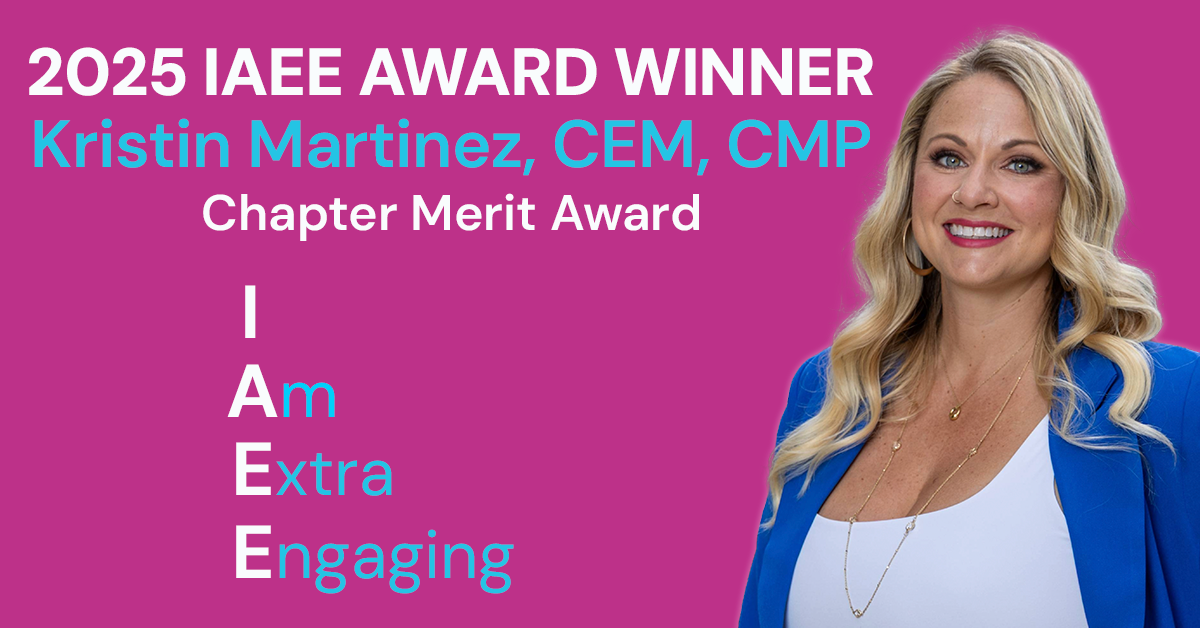
Kristin Martinez, CEM, CMP, Vice President of Events at Fast Forward Event Productions and a dedicated leader within the IAEE Southwest Chapter, has earned the prestigious IAEE Chapter Merit Award for her outstanding commitment to advancing the exhibitions and events industry. This award recognizes individuals who go above and beyond to support their local chapter’s goals while exemplifying IAEE’s core mission and values.
As a three-year Director on the SWIAEE Board, Kristin has made an indelible mark through her innovative approach to engaging the next generation of industry professionals. Her achievements include single-handedly recruiting San Diego State University as an IAEE member, creating the successful “Eventful Careers” roundtable, and serving as Co-Chair of both the YP/Academia Committee and the Program/Events Committee. What truly sets Kristin apart is her hands-on mentorship style and her ability to bridge the gap between academic learning and real-world industry practice, regularly inviting students to experience events from installation through dismantle.
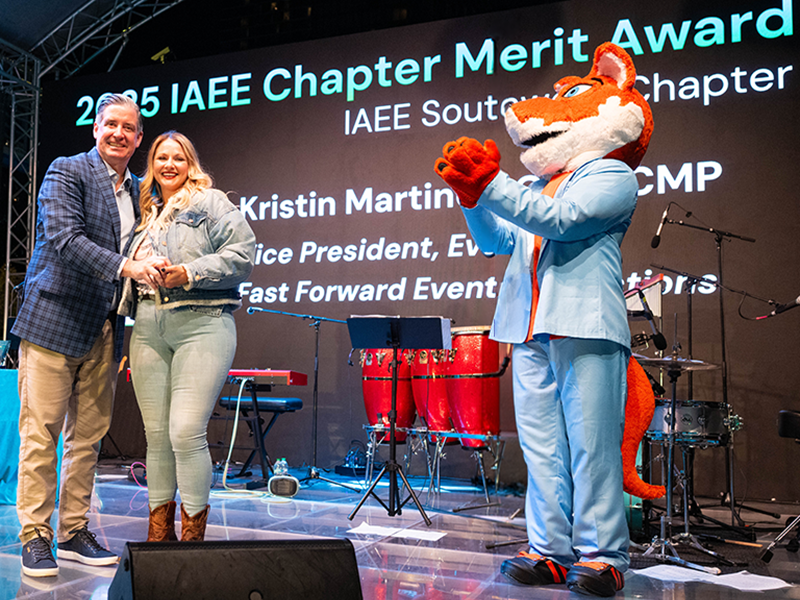
Kristin was presented with the 2025 IAEE Chapter Merit Award this past December at Expo! Expo! IAEE’s Annual Meeting & Exhibition in Houston, Texas.
In this interview, Kristin shares her insights on building academic partnerships, mentoring emerging professionals and her vision for strengthening the IAEE Southwest Chapter’s impact on the industry’s future.
Can you tell us about your approach to recruiting San Diego State University as an IAEE member and why you feel it’s important to bring academic institutions into the organization?
Kristin: My approach with SDSU was really about visibility and access. Students are often introduced to the meetings and events industry through corporate meetings, hospitality groups, hotel associations and organizations like MPI – which all have tremendous value. But there is a huge side of this industry tied to exhibitions, sponsorships, revenue strategy and large-scale event business that many students are not exposed to intentionally. Too often, people discover that side later by accident. I wanted SDSU students to see it earlier, understand it as a real career path and be able to think more strategically about where they may want to go in the industry.
Bringing SDSU into IAEE helped create that bridge. It gave students access to a part of the industry they may not otherwise see in the classroom, while also helping them better understand the business side of events. Even in corporate meetings, exhibitions, sponsors and revenue-generating event elements play an important role. Exposure to this side of the business helps students understand the full scope of the industry and gives them permission to explore beyond their initial assumptions about what an events career can look like.
You’ve created numerous opportunities for students to gain hands-on experience in the industry. What do you see as the most critical bridge between academic learning and professional practice, and how do you work to strengthen that connection?
Kristin: The most critical bridge between academic learning and professional practice is real exposure to the work as it actually happens. Students can learn theory, terminology and planning frameworks in the classroom, but this industry really comes to life when they can see the pace, complexity, problem-solving and collaboration that happen onsite. That is where the work becomes real, and where many students start to understand how wide this industry really is.
For me, strengthening that connection happens under two umbrellas that work together. One is my role with the IAEE Southwest Chapter, where I’m focused on creating access, visibility, and meaningful industry connection for students and young professionals. The other is through my work at Fast Forward, where our company actively invests in student development through internships and hands-on event exposure. I really mesh those two worlds together, because students need both: chapter-level community and direct real-world experience inside a working event business.
Through Fast Forward, we’ve created opportunities for SDSU students to come behind the scenes at San Diego Food + Wine Festival during setup, when the activations are taking shape and they can really see the mechanics of the event come to life. We walk the site, talk candidly about what is working, what is breaking and how we are solving problems in real time. For students outside of the internship program who want more hands-on experience, we invite them to volunteer onsite or step into event support roles when those opportunities are available, so they can experience registration, guest support and breakdown from the inside. We also give them the opportunity to experience the event as attendees, because understanding both the operational and guest perspective matters.
One of the biggest lessons for me has been that engagement increased significantly once I had an SDSU student intern on my Fast Forward team helping organize that connection from within the school. Peer-to-peer credibility made a real difference. When students hear from someone in their own age group who has had that experience firsthand, the buy-in changes. That is a big reason why, going forward, I want my interns involved with the YP/Academia Committee as well. I think the strongest bridge is built when industry, chapter leadership and students themselves all help shape it together.
Serving as Co-Chair of both the YP/Academia Committee and the Program/Events Committee requires juggling multiple leadership roles. How do you balance these responsibilities, and what synergies have you discovered between these two areas?
Kristin: Serving on both committees gives me a much stronger vantage point because the work is deeply connected. The Program and Events Committee is responsible for building meaningful chapter programming, while YP/Academia is focused on engaging students and emerging professionals in ways that feel relevant and valuable to them. If those conversations happen separately, it becomes very easy to create programs for young professionals and students without actually creating something they want to attend. That is where the overlap matters most.
Even with visibility into both committees, it can still be challenging to plan events that truly resonate with these audiences. Students and young professionals are selective about where they spend their time, and if we want their engagement, we have to invite them into the conversation instead of making assumptions on their behalf. That is why it is so important to have voices from SDSU, UNLV and our student communities represented in the process. As industry professionals, we can build events all day long, but if they are not meaningful to the people they are intended to serve, attendance and impact will always fall short.
One of the biggest synergies I’ve found is that bridging these committees helps us think beyond isolated YP or academia events and instead create stronger access points into the chapter as a whole. Students and young professionals do want targeted programming, but they also want access to established professionals and to the broader industry conversations happening at our regular chapter events. Keeping those groups connected helps ensure they are not just invited to separate programming, but are meaningfully included in the larger professional community.
Long term, that matters. The relationships and industry touchpoints people build while they are still in school do not disappear when they graduate. They remember the organizations, events, and communities that gave them real access early on. My goal is to make sure IAEE is one of those touchpoints, and that we are building a path where students and young professionals can see themselves in the chapter long before and long after graduation.
The “Eventful Careers” roundtable was highly successful for both students and experienced professionals. What inspired this initiative, and what key takeaways have participants shared with you?
Kristin: What inspired this initiative was the idea that students and emerging professionals need more honest conversations about what a career in this industry really looks like. When you’re in college, it’s easy to imagine a very linear path – like you pick a lane, follow the steps and arrive exactly where you thought you would. But in reality, this industry rarely works that way. Most people move between different sides of the business, take on unexpected roles and discover new strengths or interests along the way. The more obvious the path may seem at the beginning, the less likely it is to unfold exactly that way.
I wanted Eventful Careers to create space for that truth. There is no one right way to build a career in events, exhibitions or hospitality, and there really is no final “end point” where everything is perfectly figured out. The roundtable gave students and young professionals a chance to hear directly from people who have moved between supplier roles, planner roles, support functions, and leadership positions – and to understand that those pivots are not failures, they are often the path.
One of the biggest takeaways participants shared was that it felt freeing to hear how non-linear so many careers have been. It helped normalize the uncertainty they may feel about where to go next. It also made space for exploration – trying things, learning what fits, being honest when something does not and course correcting toward something that does. I think that kind of transparency is incredibly valuable, because it gives people permission to stay curious and keep building a career that is right for them, not just the one they first imagined.
What advice would you give fellow leaders who want to take make a meaningful impact in their organizations, especially when it comes to building programs that serve both emerging and experienced professionals?
Kristin: I think this is something almost anyone can do, and meaningful impact often comes from relatively simple actions done consistently. If supporting emerging professionals matters to you, one of the best places to start is by volunteering on a board or committee that works directly with students or young professionals. Those groups are often understaffed and in real need of people who are willing to invest time, energy and care.
I also think mentorship is one of the most powerful ways to make a lasting impact. One of the biggest things that shaped my own career was having mentors who saw strengths and potential in me that I did not yet see in myself. Sometimes the missing link is not just encouragement, but someone with perspective helping a person connect their skills to opportunities or career paths they had not considered. That kind of insight can change everything. As professionals, we can carry ourselves in a way that makes that possible – by being approachable, supportive and willing to share perspective in a way that helps others see a bigger future for themselves.
That mentorship does not always have to be formal to matter. Help students and young professionals network. Teach them how to walk into a room, start a conversation and make connections. When you see someone early in their career at an event who looks unsure, go talk to them. Buy them a drink, walk them around, make introductions. Help them feel like they belong there. That kind of access is often the most valuable thing you can give someone who is still trying to find their footing.
What makes this especially impactful is that it often creates mutual benefit. Many experienced professionals are stretched thin and in need of support, and many students are looking for ways to gain real exposure and experience. The right introduction can create opportunity on both sides. That “who you know” piece of this industry is real, but the most meaningful version of it is using your network intentionally to move other people forward.
I also believe impact comes from listening first. Learn what someone is interested in, what they are trying to figure out and what kind of exposure they need next. Then connect them with people, opportunities and experiences that align with those goals. It is not just about showing up to an event on paper – it is about what you do with your time once you are there and how intentionally you use it to help others grow.
Finally, I would encourage leaders to look internally at their own organizations. A lot of companies have internship programs, but many are underdeveloped or disconnected from the broader industry. There is often a real opportunity to improve those programs, create better support for interns and connect them to committees, volunteer roles, and experiences outside their immediate job function. That is where access broadens, engagement deepens and stronger future professionals begin to take shape.