
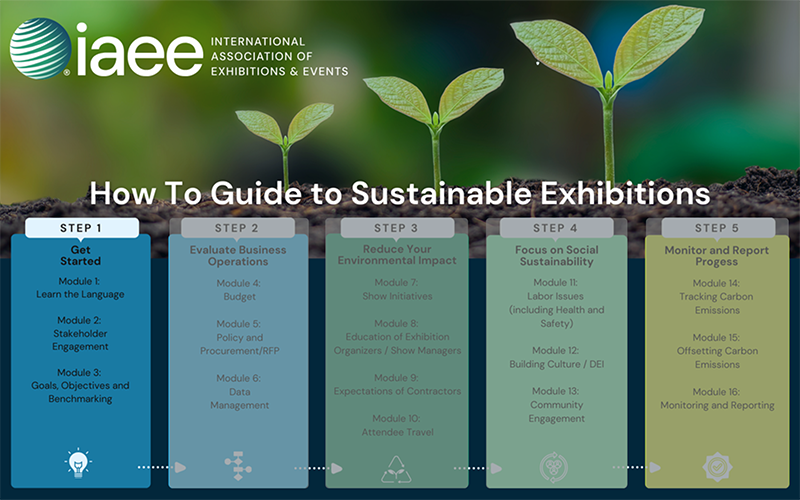
Editorial Note: This blog is the first in a five-part series based on IAEE’s “How To Guide to Sustainable Exhibitions,” a toolkit that offers exhibition organizers a practical, step-by-step framework for adopting and advancing sustainable practices to reduce environmental impact and demonstrate corporate responsibility.
STEP 1: Get Started
Sustainability doesn’t happen by accident; it starts with intention, knowledge and the right foundation. For exhibition organizers, that means understanding the language of sustainability, mapping your stakeholder landscape and setting goals you can actually measure. STEP 1 in IAEE’s sustainability toolkit consists of three modules packed with insights that are more practical and actionable than you might expect.
Speaking the Language is the First Act of Leadership
Before you can green your exhibition, you need to understand what “green” actually means in your context. Module 1 of the guide emphasizes that fluency in sustainability terminology is foundational – not just for compliance, but for credibility and decision-making. The landscape of standards, certifications and regulations is constantly evolving, and organizers who stay informed are the ones who stay ahead.
- Carbon Neutral and Net Zero are not interchangeable terms and understanding the difference shapes your emissions strategy as well as how you communicate progress to stakeholders.
- Familiarity with frameworks like LEED, BREEAM and ISO 20121 helps organizers select venues, suppliers, and practices that align with globally recognized sustainability standards.
- Staying current on regulatory requirements, particularly those emerging in the EU and from international governing bodies, protects your organization from risk and positions it as a proactive industry leader.
Knowing the language isn’t just semantics! It’s the difference between greenwashing and genuine, accountable progress.
Stakeholder Engagement is a Strategy, Not a Courtesy
One of the most underestimated drivers of sustainable exhibition success is who you bring to the table (and when). Module 2 explains why stakeholder engagement is not just a box to check after decisions are made, but an essential input into the decision-making process itself. From exhibitors and attendees to venue management, local communities and sustainability experts, each group brings perspective that shapes better outcomes.
- Early engagement with exhibitors and contractors helps surface practical constraints and opportunities that organizers might otherwise overlook when building sustainability plans.
- Involving local communities and sustainability experts builds consensus and ensures that environmental and social commitments are grounded in real-world context rather than generic policy.
- Stakeholder buy-in increases the likelihood of successful implementation. When people feel ownership over a plan, they become active participants in its success rather than passive bystanders.
The toolkit offers a structured approach to identifying, mapping and engaging your stakeholders in ways that build long-term credibility for your event.
Goals Without Benchmarks are Just Wishes
Sustainability ambition is admirable, but it requires structure to become reality. Module 3 focuses on why setting clear, measurable goals – and benchmarking against them – is critical for exhibition organizers who want to demonstrate real impact. Without a baseline, you can’t track progress. Without targets, you can’t hold yourself accountable.
- Establishing a sustainability baseline such as measuring current energy use, waste output and carbon emissions, gives you the starting point from which every improvement can be calculated and communicated.
- Setting SMART sustainability objectives (Specific, Measurable, Achievable, Relevant, Time-bound) transforms broad environmental aspirations into actionable plans that staff and partners can rally around.
- Benchmarking against industry peers and global standards (versus just your own past performance) reveals where your event stands in the broader landscape, and helps attract environmentally conscious exhibitors and attendees.
STEP 1 in IAEE’s “How To Guide to Sustainable Exhibitions” goes beyond merely offering you a starting point. It gives you a framework for building a credible, lasting sustainability practice from the ground up!