
By Mary Tucker | Senior Communications and Content Manager | IAEE
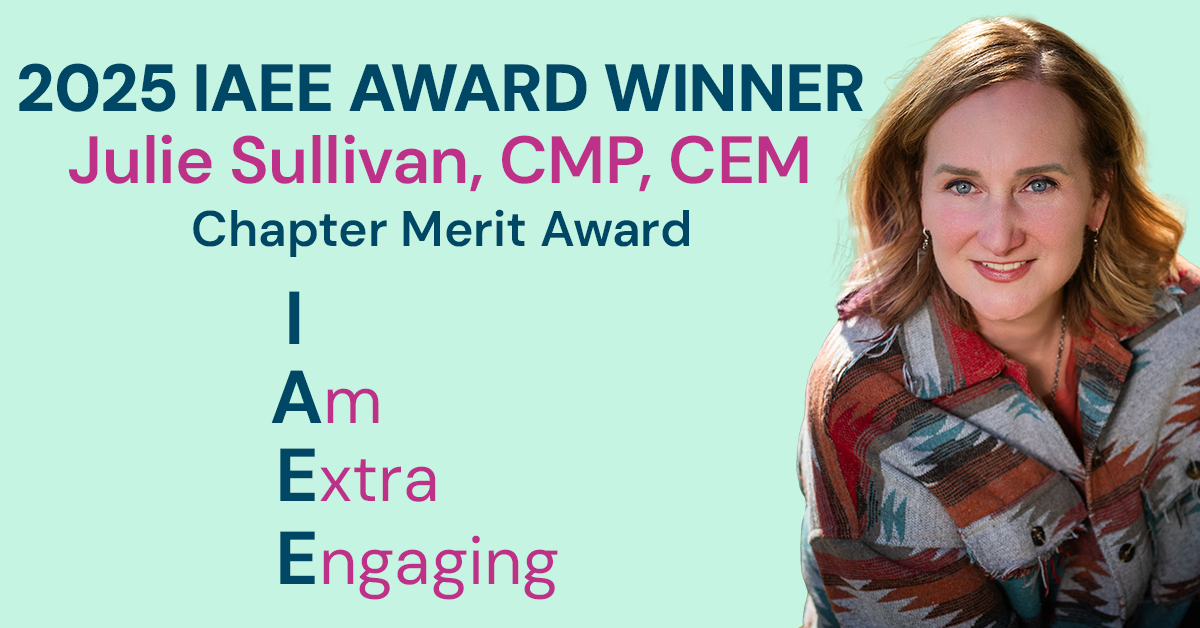
When a chapter faces its darkest hour, it takes an exceptional leader to not only steady the ship but transform it entirely. Julie Sullivan, CMP, CEM, Vice President of Business Development at ACIS Group, has done exactly that for the IAEE Rocky Mountain Chapter. Her recognition with the IAEE Chapter Merit Award celebrates far more than successful events or impressive revenue growth – it honors a leader who saw potential where others saw impossible odds.
IAEE’s Chapter Merit Award recognizes individuals who advance their local chapter’s goals while exemplifying IAEE’s broader mission and objectives. Julie’s story is one of remarkable transformation: inheriting a chapter on the verge of closure and rebuilding it into a financially stable, thriving organization that now serves as a model for chapters nationwide.
Her achievements speak volumes: growing sponsorship revenue by 400% over three years, increasing the chapter’s flagship reception attendance from just 10-15 people to 62, and orchestrating the highest-attended event in Rocky Mountain Chapter history. But numbers alone don’t capture Julie’s impact. Across a six-state region spanning Colorado, New Mexico, Utah, Wyoming, North Dakota and South Dakota, she has created sustainable governance structures, forged strategic partnerships and built a leadership pipeline designed to ensure the chapter’s success for years to come.
With 15 years of IAEE involvement, including service on the CEM Commission and leadership roles in multiple chapters, Julie brings both crisis management expertise and visionary thinking to every challenge she encounters.
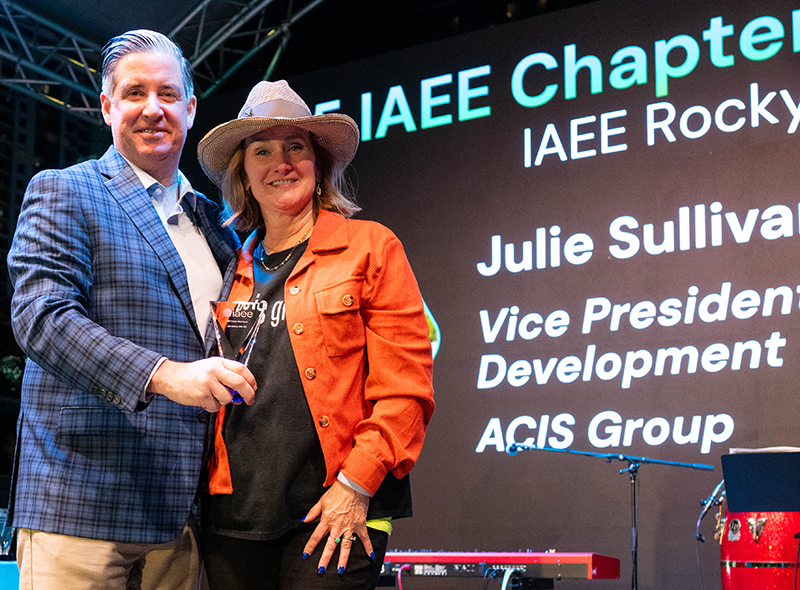
Julie was presented the 2025 IAEE Chapter Merit Award this past December at Expo! Expo! IAEE’s Annual Meeting & Exhibition in Houston, Texas.
We sat down with Julie to discuss her journey from crisis intervention to chapter transformation, the strategies that turned the Rocky Mountain Chapter around, and her vision for the future of IAEE leadership.
Take us back to that critical moment when you recognized the Rocky Mountain Chapter was in crisis: what did you see and what made you decide to step forward rather than step back?
Julie: The pandemic scattered our region’s membership to the winds, leaving people completely disinterested, disengaged and non-committal. There were just a handful of us doing all the chapter work. Things got pretty dire, and we decided to contact IAEE National about our options, including closing the chapter.
When you are finally faced with the decision to shut it all down or press on, you find the drive to make another charge. So, we committed to persevering and seeing if we could make it work. Fast forward four years, and the chapter is now a thriving, bustling chapter with all of our leadership positions filled, events and education almost every month, bringing members and area professionals together in exciting venues. And we finally have enough money to run comfortably. It’s a testament to the sheer determination, willpower and flexibility of our leadership.
Growing sponsorship revenue by 400% is extraordinary! What was your approach to creating the chapter’s first formal sponsorship prospectus and how did you convince sponsors to invest in a struggling chapter?
Julie: My experience with the Washington, D.C. Chapter Board as its Director of Sponsorships was instrumental in my transition to the Rocky Mountain Chapter and developing a formal sponsorship program and prospectus on their behalf. I just needed some help on fleshing out attractive deliverables and a consensus on pricing for the RMC market. Our Chapter Admin and I sat down for a few hours, and we hammered out our first prospectus.
Sponsors don’t always know the struggles of a chapter unless they serve on the Board, and the RMC has traditionally always been very good about getting our calendar squared away early. The recipe for our sponsorship growth over the last three years was developing and nurturing relationships with prospects and returning sponsors, delivering on what was promised, building trust, and, quite frankly, making the ask. Making the ask over and over again and having a solid sales process established by the Sponsorship Committee. We also re-evaluated our pricing as venues and costs changed over the years.
You’ve transformed event attendance from 10-15 people to record-breaking numbers. What’s your secret to creating programming that resonates so powerfully with members, and how do you balance exceptional value with financial sustainability?
Julie: We are offering a blend of opportunities in our chapter region to see what resonates with area planners and suppliers. We have a solid mix of first-time programming, virtual and face-to-face meet ups, and annual member appreciation activities. I think this mix has kept members and non-members alike interested in us this past year, and I really hope we continue to see an upward trend in our numbers.
We’ve had to be creative with venues, programming ideas, and doubling up on co-sponsors to keep our margins in our comfort zone. It’s been so thrilling and rewarding to watch our programs take off this year.
Leading across a six-state region presents unique challenges. How have you built sustainable governance structures and developed a leadership pipeline to ensure the chapter’s success continues beyond your tenure?
Julie: This is the RMC’s most significant area for growth in 2026 and has been our biggest challenge to date since I’ve served on the Board. We are in great shape this year, with all of our Executive Committee and Board positions filled, but we still have one key position vacant for 2027. I’ve set a precedent that the RMC Governance Committee will need to be fleshed out with 5-6 more members, and they will be tasked with shoring up our leadership pipeline and managing and updating our recently approved policies and procedures set forth by the Chapter Policies and Procedures Task Force and IAEE National this past year.
Your 15-year IAEE journey spans service on the CEM Commission, Board leadership in multiple chapters, and participation in the Chapter Policies and Procedures Task Force. How have these diverse experiences shaped your approach to leadership, and what best practices have you developed that other chapters might replicate?
Julie: A My sweet spot is keeping my IAEE activities balanced between leading, giving back and learning something completely new. I look forward to serving this year on the Women’s Leadership Forum and developing programming for all women and men to lead successfully in 2026 and beyond. I hope to potentially create something as meaningful in our region for the RMC membership and to entice non-members to join our Rocky Mountain Community.