

Editorial Note: This blog is the second in a five-part series based on IAEE’s “How To Guide to Sustainable Exhibitions,” a toolkit that offers exhibition organizers a practical, step-by-step framework for adopting and advancing sustainable practices to reduce environmental impact and demonstrate corporate responsibility. Read Part 1 here.
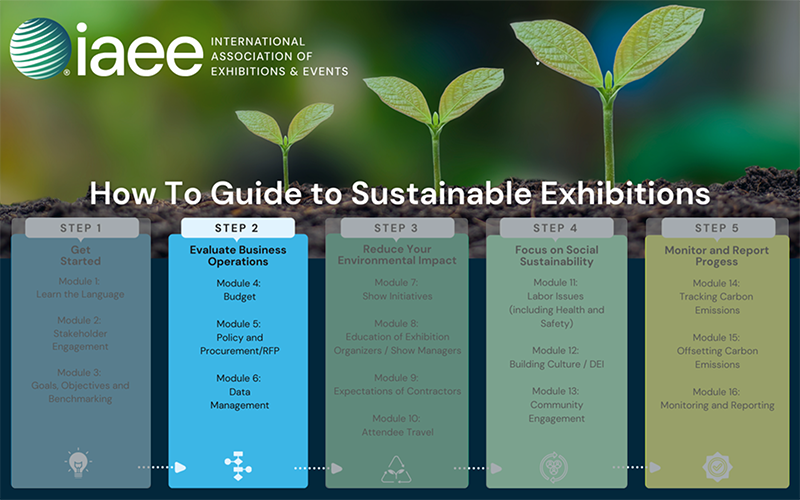
STEP 2: Evaluate Business Operations
Sustainability is often framed as a values issue, but it’s also a business issue. STEP 2 in IAEE’s sustainability toolkit digs into the nuts and bolts of how your organization’s budget, procurement policies and data management practices either support or undermine your sustainability goals. The findings in this section may surprise you… and they will almost certainly challenge you to rethink how your back-office decisions shape your environmental footprint.
Your Budget is a Sustainability Statement
Where you allocate dollars signals what you value. Module 4 on budgeting makes the case that creating a sustainable exhibition isn’t just about adding a recycling program; it’s about intentionally structuring your financial resources to minimize environmental harm and maximize long-term value. The guide provides concrete examples of what a sustainability-forward budget actually looks like in practice.
- Budgeting for eco-friendly materials such as recycled paper, biodegradable banners and non-toxic inks upfront reduces waste disposal costs downstream, and signals your commitment to exhibitors and attendees.
- Allocating funds for energy-efficient lighting and equipment, including LED systems, generates measurable cost savings over time while reducing your event’s carbon footprint.
- Setting aside a carbon offsetting line item to cover unavoidable emissions from attendee travel and venue energy use demonstrates fiscal responsibility alongside environmental accountability.
The guide helps you see your budget not as a constraint on sustainability, but as one of your most powerful sustainability tools.
Policy and Procurement Drive Real Change
You can’t build a sustainable exhibition on ad hoc vendor decisions. Module 5 focuses on policy and procurement, the organizational infrastructure that ensures sustainability isn’t dependent on any one champion but embedded into how your team operates every day. From formal environmental commitment statements to supplier selection criteria, this module covers the policies that turn intention into institutional practice.
- Developing a written environmental commitment policy gives your organization a north star that guides every procurement decision and creates a public accountability standard you can report against.
- A sustainable procurement policy with clear criteria for vendor selection reduces your supply chain’s environmental impact and increasingly aligns your practices with the expectations of corporate exhibitors who have their own ESG commitments.
- Embedding sustainability language into your RFP process ensures that eco-friendly performance is evaluated alongside cost and quality, making green suppliers the norm rather than the exception.
The policy and procurement frameworks in STEP 2 are among the most actionable and transferable tools in the entire guide.
Data Management is Your Sustainability Backbone
You can’t manage what you don’t measure. Module 6 on data management addresses one of the most overlooked aspects of sustainable exhibitions: the systems and practices needed to collect, track and use environmental data effectively. This isn’t just about reporting, it’s about building the operational intelligence to continuously improve.
- Establishing consistent data collection processes for energy consumption, waste diversion rates and water usage creates the baseline from which all meaningful improvement is measured.
- Centralizing sustainability data across events and vendors, rather than leaving it siloed in departmental spreadsheets, enables leadership to see the full picture and make smarter decisions.
- Strong data management practices are increasingly required for credible sustainability reporting to stakeholders, sponsors and regulators, thereby positioning your organization as a transparency leader in the industry.
STEP 2 in IAEE’s “How To Guide to Sustainable Exhibitions” transforms sustainability from a philosophical commitment into an operational reality.