
By Mary Tucker | Senior Communications and Content Manager | IAEE
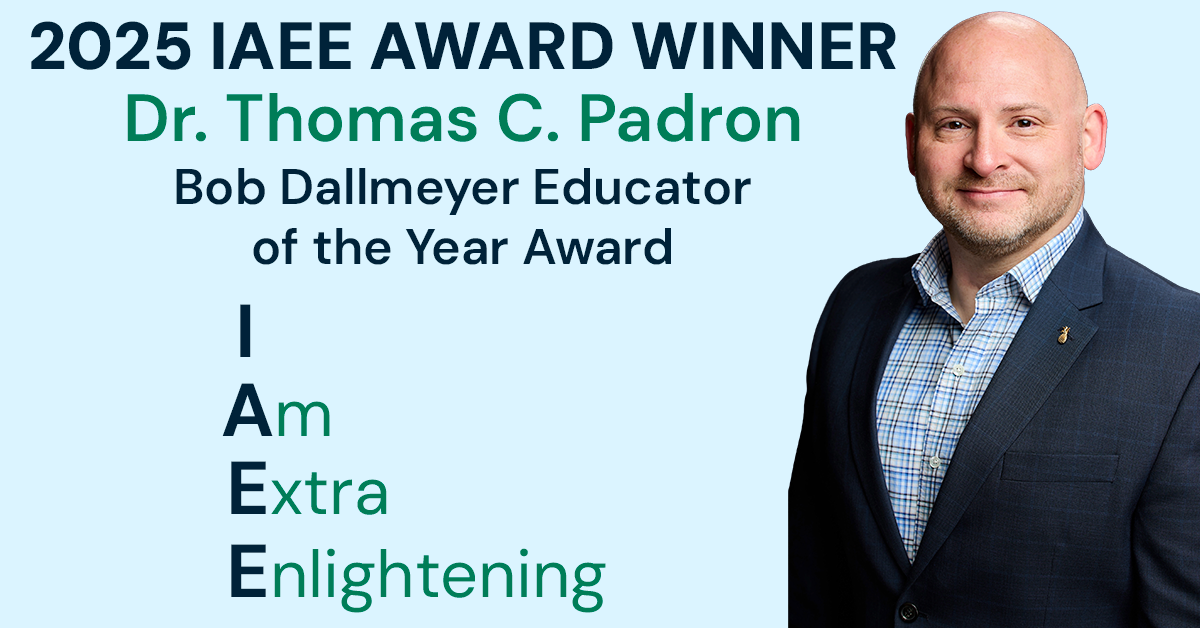
The IAEE Bob Dallmeyer Educator of the Year Award recognizes members who exemplify excellence in education through outstanding creativity, infectious enthusiasm and the exceptional ability to inspire lifelong learning among industry professionals. This prestigious honor celebrates educators who do not just present the information; rather, they transform how knowledge is shared and applied in the exhibitions and events industry through innovative methods and meaningful connections.
Dr. Thomas C. Padron, CMP, CHE, CWP, Professor and Program Coordinator of Hospitality and Tourism at California State University, East Bay, definitely understands the assignment. Thomas has distinguished himself through his groundbreaking integration of emerging technologies like artificial intelligence into the classroom, his commitment to experiential learning at major industry events, and his dedicated service as a Past Chairperson of the IAEE Faculty Advisory Committee and current Co-Chair of the IAEE Faculty Engagement Programs for IMEX America and IMEX Frankfurt.
With more than 25 years of industry experience, Thomas masterfully bridges the gap between academic theory and practical application, inspiring students to see themselves as future leaders while instilling both technical expertise and ethical standards that will guide their careers.
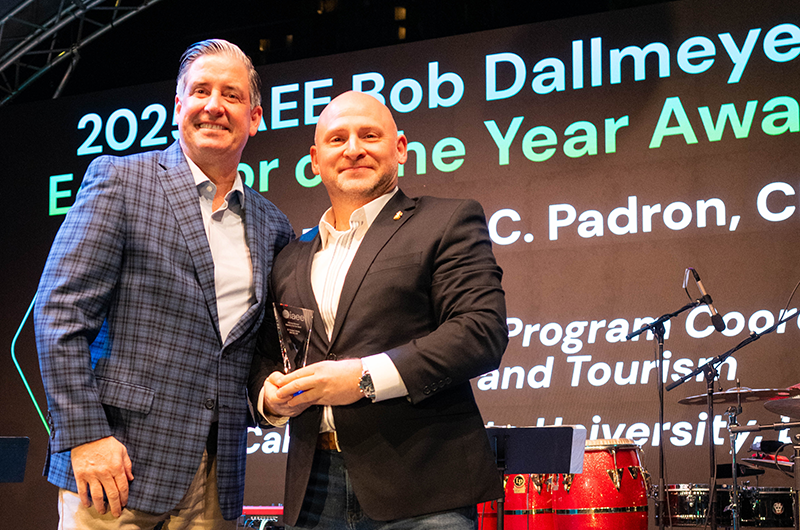
Thomas was presented the 2025 IAEE Bob Dallmeyer Educator of the Year Award this past December at Expo! Expo! IAEE’s Annual Meeting & Exhibition in Houston, Texas.
Here, Thomas shares insights into innovative teaching methods, the power of experiential learning, and his vision for preparing the next generation of exhibitions and events professionals.
How has your integration of artificial intelligence and other emerging technologies transformed the way you teach and engage students in the hospitality and tourism program?
Thomas: We are co-learning, meaning my students and I are learning artificial intelligence and other technologies together. The ever-changing world of AI keeps me engrossed in webinars and articles on a regular basis. I then share the information with my students to keep all of us relevant. The application of technology has changed the way we think and how we work. Utilizing them as tools to assist students in further developing their critical thinking and analytical skills is essential.
It is important for them to remain curious about the possibilities of what AI can bring to an already dynamic industry. I encourage them to not be afraid to try something new or different. This is exactly why I recreate my courses each time I teach them. The courses need to reflect the changes that are happening so that students are prepared with relevant information.
Can you describe a memorable moment when you saw a student make that crucial connection between classroom learning and real-world industry practice?
Thomas: The “ah-ha moments” as an instructor happen all of the time as I remember what my professors talked about, and the same is true for my students. When they “get it” you feel like a proud parent. Whether it is students who are attending a conference with me and are in a session or on the show floor and they make the connection from the classroom to the real world.
This also applies to projects or group projects when they realize that they have a passion for the industry and go above and beyond to produce a superior product. These moments are where the spark ignites the flame in them. They see the potential, the possibilities, and the opportunities that are before them. You begin to see them change and mature through each semester, and each course.
As a past chair of the IAEE Faculty Advisory Committee, what do you see as the most important message we need to communicate to students about the unique value and career opportunities in our industry?
Thomas: Diversity of people, opportunities, environments, and possibilities. The industry is so vast, yet such a collective community of passionate individuals. We saw this during the pandemic, and it was such a refreshing and welcoming feeling. People came out of the woodwork to help one another, and it really was heartening to witness true selflessness.
The best part is this was not something that was short lived. That sense of community and wanting to help is still going strong and gets stronger with every challenging situation. The industry is a wealth of amazing people who, at their core, are all about service.
Drawing from your 25+ years of industry experience, how do you balance teaching technical skills with instilling the ethical standards and professional values that will guide students throughout their careers?
Thomas: You model it in everything that you do. You have the responsibility to set an example and set the bar high. Trust is built with each interaction; this includes consistently showing them what industry expects and providing examples of specifics for them to review and reflect upon. It is setting a standard and guiding them to achieve each standard. This is where growth and confidence begin. The industry sets the standard, and it is my charge to communicate effectively and consistently throughout each assignment, project, and course.
What advice would you give to other educators who want to create more meaningful industry partnerships and provide students with authentic experiential learning opportunities?
Thomas: It takes a concerted effort to make things happen, and it is called work. Being involved in associations and attending conferences (local, regional, national, or international), is a great way to meet industry leaders. They have such a wealth of knowledge and experience and are willing to share their stories and time. I believe that each industry professional wants to help in any way that they can to make things better for students and emerging professionals.
Another opportunity is with other faculty, including myself. Many are willing to share what they are doing in their respective programs and courses and look to collaborate on new, innovative, and creative ideas. The connection between education and industry is vital to ensure that we prepare industry-relevant and industry ready professionals.