

Editorial Note: This is the final blog in a five-part series based on IAEE’s “How To Guide to Sustainable Exhibitions,” a toolkit that offers exhibition organizers a practical, step-by-step framework for adopting and advancing sustainable practices to reduce environmental impact and demonstrate corporate responsibility. Click on the links to catch up on previous installments of the series: Part 1, Part 2, Part 3 and Part 4.
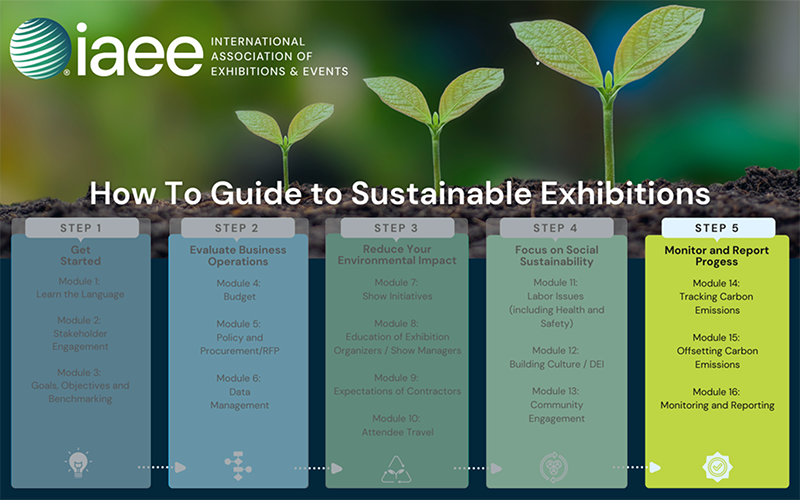
STEP 5: Monitor and Report Progress
All the planning, policies and initiatives in the world mean little if you can’t demonstrate that they’re working. STEP 5 in IAEE’s sustainability toolkit tackles the part of the sustainability journey that many organizations rush through or skip altogether: monitoring, reporting and continuous improvement. Whether you’re tracking carbon emissions, evaluating offset strategies or communicating results to stakeholders, this final step is what transforms good intentions into a credible, evolving practice.
Carbon Tracking is the Foundation of Honest Accountability
You cannot claim sustainability leadership without knowing your numbers. Module 14 on Tracking Carbon Emissions provides exhibition organizers with a clear framework for measuring the greenhouse gas impact of their events, from venue energy use to attendee travel to food and beverage logistics. This data isn’t just for reports; it’s the intelligence that drives smarter decisions.
- Understanding Scope 1, 2 and 3 emissions in the context of exhibitions enables organizers to see the full picture of their carbon footprint. This goes beyond the obvious on-site energy costs, including the upstream and downstream impacts of every operational choice.
- Using standardized emissions calculation methodologies ensures that your data is credible, comparable across events and aligned with the frameworks that sponsors, exhibitors and regulators increasingly require.
- Tracking carbon over multiple events enables longitudinal analysis that reveals trends and validates the impact of sustainability investments, thereby providing the evidence base for public commitments and continuous improvement goals.
The guide demystifies carbon tracking for exhibition professionals who aren’t sustainability specialists, making it accessible and actionable for teams of any size.
Carbon Offsets Are a Tool, Not a Shortcut
Even the most sustainability-optimized exhibition will generate some unavoidable emissions. Module 15 on Offsetting Carbon Emissions addresses how to approach carbon offsets strategically – not as a way to claim environmental virtue without doing the hard work, but as a legitimate complement to genuine emissions reductions. Understanding the offset landscape is increasingly essential for exhibition organizers making public net-zero commitments.
- Not all carbon offsets are equal. The guide helps organizers evaluate offset projects by quality, verification standard and co-benefits, ensuring that purchased offsets deliver genuine environmental value rather than paper carbon credits.
- Prioritizing emissions reductions before pursuing offsets, and being transparent with stakeholders about this sequencing, builds credibility and protects your organization from greenwashing accusations in an increasingly scrutinized landscape.
- Investing in offset projects aligned with your community values, such as local reforestation or renewable energy in your host region, can amplify the social and reputational benefits of your offset strategy beyond pure carbon accounting.
Module 15 provides the conceptual grounding and practical criteria exhibition organizers need to make confident, defensible offset decisions.
Transparent Reporting is a Competitive Advantage
Module 16 on Monitoring and Reporting makes a powerful argument: in today’s stakeholder environment, transparency about sustainability performance is not only an ethical obligation, but a strategic differentiator. Organizations that report clearly and honestly on their environmental and social outcomes build deeper trust with exhibitors, attendees, sponsors and the communities they serve.
- Systematically monitoring key performance indicators such as energy consumption, waste diversion rates, carbon emissions and social impact metrics creates the evidentiary foundation for credible reporting and continuous improvement planning.
- Aligning your sustainability reporting with recognized frameworks such as GRI (Global Reporting Initiative) or ISO 20121 signals to sophisticated stakeholders that your disclosures meet internationally accepted standards of rigor and completeness.
- Sharing your sustainability results publicly – including challenges and areas for improvement, not just successes – positions your organization as an authentic leader and inspires others in the industry to raise their own standards.
STEP 5 closes the loop on the entire sustainable exhibitions journey, connecting every action back to measurable outcomes and forward to continuous improvement.